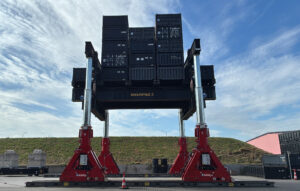
Transporting $10bn James Webb Space Telescope to its launch pad required Ro/Ro carrier of high value goods to load and transport the highly sensitive cargo with zero margin for error
The most powerful space observatory ever built, the James Webb Space Telescope (JWST), is now orbiting the sun about a million miles from Earth and sending images that offer special insights into the birth of stars and planets.
Less spectacular, but still special, was the remarkable journey this precious cargo made before launch, which French ship owner and manager Compagnie Maritime Nantaise (CMN) described to The Heavy Lift Group gathering in The Hague in May.
CMN specializes in the transportation of high value, sensitive and dangerous goods, personnel and military sealift, and the JWST mission demanded absolute precision with zero margin for error.
Led by Mathias Audrain, CMN’s Commercial & Business Development Manager, the project was one of the most challenging ever handled by the company. CMN had to safely load the precious cargo in its ultra-sensitive STTARS container and deliver it intact to Europe’s Spaceport in Kourou.
The $10bn project to design and build the largest telescope in space had begun in 2003 and the planning for its transport to the launch pad in French Guiana started nearly a decade before CMN loaded it onboard the 4,171-dwt roll-on/roll-off vessel MN Colibri south of Long Beach, on 26th September 2021.
The 2000-built MN Colibri was specially designed and built to transport components of the launcher Ariane 5, with its 336 metric ton capacity axial stern ramp and its guaranteed draft of 3.80m ideal for Kourou. However, to handle the JWST, garage modifications were required.
The loading operation also demanded far more than a standard port-to-port shipment. Under strict NASA requirements and a binding non-disclosure agreement, the partners had to identify a loading site that offered a flat and structurally sound pier, adequate draft depth, controlled ramp angles for Ro/Ro operations, and complete security with minimal public exposure.
Several piers in Long Beach were ruled out due to factors including aging infrastructure, shallow waters, or proximity to the public but after an exhaustive search, NASA identified the Seal Beach Military Pier as the only site that met both the technical requirements and strict security protocols.
Special loading solution
However, without proper facilities for the vessel’s ramp, CMN and its partners needed to engineer a unique and highly specialized loading solution. This involved the design of a custom bridge structure to span the gap between the pier and a barge so as to create a seamless, secure pathway.
Loading day was a symbolic event in its own right with several dozens of engineers, technicians, and mission staff, some of whom had worked on JWST for over two decades, gathered to witness the telescope’s departure.
“What made this project unforgettable wasn’t just the scale of the logistics,” said Audrain. “It was the people. You could feel the emotion in the air as this long-awaited journey to space finally began.”
The operation to move the containerized JWST into the MN Colibri required absolute precision with every aspect meticulously validated through photogrammetry, 3D modeling, on-site measurements, and load simulations to ensure that vibrations, tilt, or misalignment risks were fully mitigated.
After a detailed lashing and stowage plan was developed to secure the cargo at sea without inducing stress or imbalance, it was finally rolled onto the barge at Eel Pt., secured by a spud barge, which then had to be turned to allow it to be gently rolled across into the MN Colibri garage via its axial stern ramp.
A 16-day specially routed 5,800-mile voyage followed, via the Panama Canal, with the JWST’s electrical connections monitored by NASA technicians with the help of vessel’s crew who ensured cleanroom-level isolation throughout. The telescope arrived at Port de Pariacabo in French Guiana on 12th October 2021 ahead of its launch on 25th December.
Audrain added: “Compagnie Maritime Nantaise’s role in the transport of the James Webb Space Telescope demonstrated not only technical mastery, but also the critical value of foresight, collaboration, and innovation under pressure.
“it is such a pleasure to see our efforts were part of such a hugely successful project that is now paying off with the telescope detecting some of the most distant known galaxies, black holes and new planets which could not before be seen.”
Nantes-based CMN is a Sogestran Group company that operates five Ro/Ro vessels and is also registered as a freight forwarder.